Meta’s Teenage Mental-Health Controls: From Engagement to Responsibility

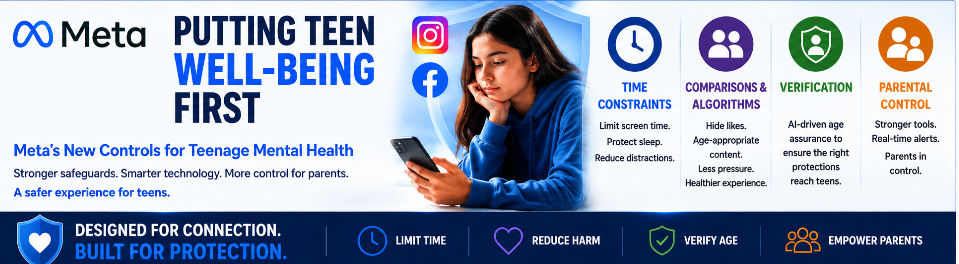
For years, the debate around teenage mental health and social media has focused on how much responsibility should sit with parents, teenagers and the platforms themselves. Meta’s Teenage controls latest measures suggest an important change in that equation. The company is moving beyond warnings, screen-time reminders and parental supervision towards embedding safeguards directly into the design of Instagram and Facebook.
The significance goes beyond a two-hour usage limit. Meta is beginning to address the four dimensions of the social-media experience that can influence teenage well-being: time spent, social comparison and algorithmic exposure, age verification, and parental oversight.
The underlying principle is simple: if a platform can use technology and algorithms to maximise engagement, it can also use technology to reduce the risks associated with that engagement.
This represents a potentially important shift—from “use social media responsibly” to “design social media responsibly.” The real test, however, will be whether these controls meaningfully change teenage behaviour and exposure, rather than simply adding another layer of safety features around an engagement-driven ecosystem.
Meta’s Teenage Mental-Health Controls: A Shift from Engagement to Well-being
Meta’s latest agreement with U.S. state attorneys general marks a significant shift in how Instagram and Facebook will manage teenage use. Rather than relying primarily on parental supervision or voluntary “take a break” reminders, the new framework introduces platform-level controls designed to limit excessive use, reduce social pressure, verify age and give parents greater control. The measures are subject to judicial approval.

1. Time Constraints — control the quantity of exposure
Two-hour daily limit for users under 18, cumulative across Facebook and Instagram.
Teens cannot switch off the limit without parental permission.
Midnight–6 a.m. Night Mode blocks access to major platform features.
School Mode, with notifications muted between 8 a.m. and 3 p.m.
Prompts after 15 minutes of continuous use, and at 60 and 90 minutes, encouraging more intentional usage.
2. Control Social Pressure — control the quality of exposure
This is arguably the most important mental-health dimension.
Likes and reactions are hidden by default, reducing popularity pressure and social comparison.
Teens can choose a non-personalised, algorithm-free feed rather than letting recommendations determine what they see.
Autoplay can be switched off, reducing passive, continuous consumption.
Age-appropriate 13+ content settings are applied by default.
Meta will continue restricting potentially harmful content and interactions with inappropriate accounts.
3. Verification — make sure the protections reach the right users
Meta is strengthening AI-based age assurance to identify users who appear to be under 18, even when they have entered an adult birthday. The company says it uses signals from profiles, posts, comments, captions and visual content to estimate age.
This is critical because a safety control is only effective if the platform knows who a teenager is.
4. Parental Control — put parents closer to the decision-making loop
Parents will receive stronger supervision tools, including:
Approval required to override key restrictions.
Greater visibility into a teenager's usage.
Alerts when a teen links a secondary account.
Alerts concerning interactions with potentially suspicious accounts.
Alerts when a teen repeatedly searches for terms associated with suicide or self-harm.
The bigger significance
The four pillars can be summed up as:
LIMIT TIME → REDUCE SOCIAL PRESSURE → VERIFY AGE → EMPOWER PARENTS
The important policy change is that responsibility is increasingly moving from the teenager and parent to the platform itself. Meta is being required to change aspects of the product that can contribute to excessive or unhealthy use—not simply tell parents to supervise their children.
However, there remains an important limitation: the algorithm itself has not been eliminated. Teens can opt for a non-personalised feed, but it is not simply the case that all recommendation algorithms disappear. Critics therefore argue that the settlement addresses the symptoms of engagement-driven design more strongly than the underlying business model.
In one line: Meta is moving from “parents manage teenage social-media use” toward “the platform must actively manage the risks created by teenage social-media use.”


Hey there, this is really great content.I thank you for taking the time to share this valuable information.The visitors are always interested because of the high quality of the material. www.rushtranslators.com